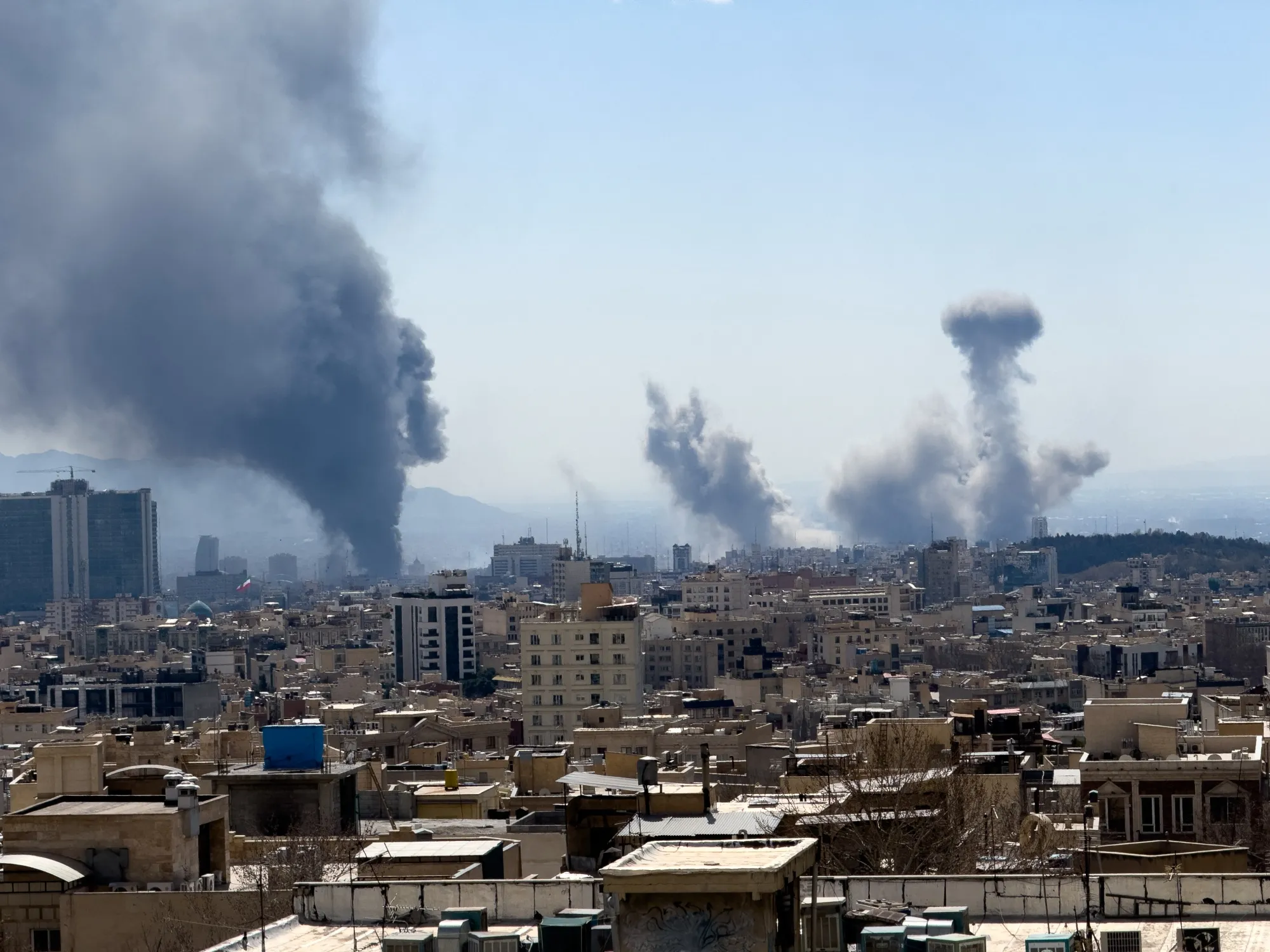
Retaliatory strikes rippled through Israel and several Gulf nations on Saturday, sending shockwaves across an already tense region.
In the United Arab Emirates, officials confirmed that at least one person was killed after missile debris fell from the sky—an alarming reminder that even fragments of war can turn deadly. As sirens wailed and air defenses lit up the night, the violence underscored just how quickly the conflict is escalating—and how far its impact may spread.
As the United States and Israel launched a coordinated military offensive against Iran early Saturday, Tehran moved quickly to make good on its vow of retaliation. Missiles and drones were directed at U.S. interests and allied targets across the Middle East, signaling that the response would be anything but symbolic. The sweeping counterstrike has raised urgent fears that what began as a targeted operation could spiral into a far wider regional conflict—one with consequences that may extend well beyond the battlefield.
Iran’s semiofficial Fars news agency reported that missile strikes were aimed at key U.S. military installations across the region, including the Al Udeid Air Base in Qatar, Ali Al Salem Air Base in Kuwait, Al Dhafra Air Base in the United Arab Emirates, and the headquarters of the United States Fifth Fleet in Bahrain.
But the barrage did not stop there. Israel, Jordan, and Saudi Arabia were also struck on Saturday, widening the scope of the confrontation and underscoring how quickly the conflict is spilling across borders—raising the stakes for the entire Middle East.
For weeks, as the United States steadily reinforced its military presence across the region, Iranian officials issued increasingly stark warnings. They vowed not only to retaliate against Israel, but to “turn all U.S. interests, bases, and centers of influence” into legitimate targets. The message was unmistakable: if conflict erupted, it would not be contained. Now, those threats are no longer just rhetoric—they are shaping a rapidly escalating reality that could redraw the region’s security landscape.
Saturday’s response was broad and unmistakable—but it stopped short of the overwhelming force many had braced for. While the strikes spanned multiple fronts, the scale and intensity appeared more measured than feared, leaving analysts and regional leaders questioning whether this was a calculated warning shot—or merely the opening move in a far more dangerous escalation.
It is still too soon to measure the full scope of Iran’s response, but early indications suggest it has been more dispersed and less concentrated than during last June’s 12-day war, when nearly 600 missiles were fired at Israel. For now, the pattern appears calculated rather than overwhelming—raising a critical question: is this a restrained show of force, or the first phase of something far more intense?
Where Iran Struck Back
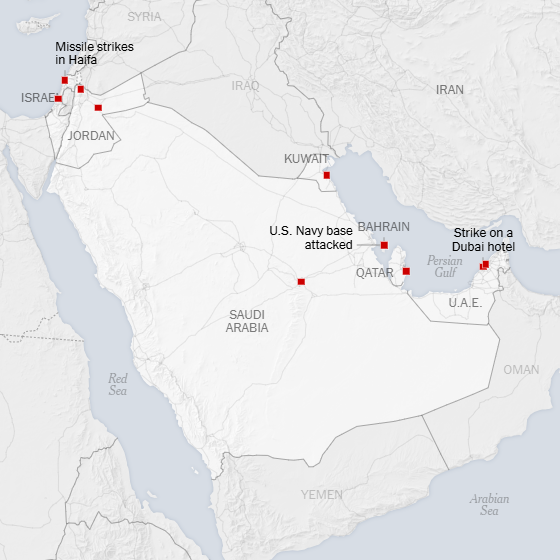
Sources: Iranian state news agency, verified satellite images and video. Lazaro Gamio, Samuel Granados, Pablo Robles, Daniel Wood/The New York Times
Later in the conflict, U.S. forces struck three Iranian nuclear facilities, escalating tensions to a new and dangerous level. Tehran did not respond immediately. Instead, more than a day later, it launched missiles at the American Al Udeid Air Base in Qatar. Most of the incoming missiles were intercepted, and no casualties were reported—but the delayed retaliation underscored a calculated strategy. The exchange signaled that both sides were willing to push the envelope, while still appearing to measure just how far the confrontation could go.
The strikes were widely viewed as measured—more symbolic than devastating—and Iran had reportedly alerted both the United States and Qatar in advance. In a surprising turn, Donald Trump publicly thanked Tehran for what he described as restraint, declaring that it was “time for peace.” The carefully calibrated exchange left observers wondering whether both sides were signaling a desire to de-escalate—or simply pausing before the next move.
Saturday’s retaliation, aimed at multiple U.S. interests across several countries, sent a sharp signal that the conflict may be entering a far more dangerous phase. By widening the battlefield beyond a single front, the strikes heightened fears that civilians, critical infrastructure, and regional stability itself could soon be caught in the crossfire. What began as targeted military exchanges now carries the unmistakable risk of a broader escalation—one that could reshape the security landscape of the Middle East.
"The Iranians are responding by spreading the pain across the region and seeking to impose costs on U.S. allies and partners who host U.S. forces and bases," said Dana Stroul, research director at the Washington Institute for Near East Policy and a former deputy assistant secretary of defense for the Middle East.
Her assessment underscores a deliberate strategy: rather than concentrating their response in one arena, Tehran appears intent on widening the pressure points—forcing Washington’s regional partners to weigh the risks of their alliances as the conflict intensifies.
Among the countries targeted on Saturday was the United Arab Emirates, where the Defense Ministry said its air defenses successfully intercepted several missiles launched from Iran. Yet even a successful interception could not prevent tragedy. According to officials, falling debris struck a residential neighborhood in Abu Dhabi, killing one person and damaging nearby property. The incident served as a stark reminder that in modern warfare, danger does not end in the sky—its consequences can still land squarely at home.
Jordan’s state-run news agency reported that the country’s military intercepted two ballistic missiles after they entered its airspace, though officials stopped short of identifying their origin. The brief statement left as many questions as answers, underscoring how quickly the conflict is bleeding across borders—and how even nations not directly involved are being drawn into its widening arc.
Qatar’s Defense Ministry said its air defenses intercepted at least two waves of incoming missiles, signaling a sustained attempt rather than a single strike. In a separate statement, the Interior Ministry reported no casualties and no damage to residential areas. For now, the country appears to have avoided the worst—but the back-to-back attacks highlight how rapidly the conflict is intensifying and how little margin for error remains.
Saudi Arabia said its air defenses intercepted attacks aimed at the capital, Riyadh, as well as the country’s eastern region, preventing what officials suggested could have been far more serious damage. The kingdom swiftly condemned what it called “cowardly” Iranian strikes on its territory. The strong language signaled more than outrage—it reflected growing alarm that the confrontation is no longer confined to traditional front lines, but is pressing deeper into the heart of the Gulf.
In an earlier statement on Saturday, the Saudi government voiced strong support for fellow Arab nations that had come under retaliatory fire, pledging to stand with them and provide assistance. The message signaled more than routine diplomacy—it underscored a growing sense of regional solidarity as tensions mount, and hinted at the possibility of a more coordinated response if the conflict continues to expand.
The Strait of Hormuz, one of the world’s most critical maritime chokepoints, was described as “effectively closed,” according to Tasnim, a news outlet affiliated with the Islamic Revolutionary Guard Corps. If true, the implications would be immediate and far-reaching: roughly one-fifth of the world’s oil and liquefied natural gas flows through this narrow passage. Any sustained disruption could jolt global energy markets, rattle economies, and transform a regional confrontation into a worldwide economic shock.
Sirens wailed across Israel in the hours after it launched its strikes on Iran, sending residents scrambling for shelter as the threat of retaliation became immediate. Israeli media reported that Iranian missiles hit Tirat Carmel, in the Haifa District, where a large fragment slammed into a residential building. The impact caused significant structural damage and injured one resident—an unsettling reminder that even a single piece of falling debris can turn a distant exchange of fire into a personal crisis at home.
In Umm al-Fahm and another community in northern Israel, officials reported minor injuries as emergency crews fanned out to assess the damage. Debris and impact sites were later identified in Jerusalem, Beit Shemesh, Kafr Manda, Kafr Harif, and parts of southern Israel, underscoring how widely the strikes were felt. What might appear as scattered impact points on a map translated, on the ground, into shattered glass, shaken neighborhoods, and a population once again bracing for what could come next.
No fatalities have been reported in Israel so far, according to the country’s emergency service, Magen David Adom, which said in a social media post that the only injuries occurred as people rushed to shelters. While the absence of direct casualties offered a measure of relief, the frantic dash for safety revealed the deep anxiety gripping communities—where even seconds can mean the difference between safety and catastrophe.
Iran also backs what it describes as an “axis of resistance,” relying on proxy groups across the Middle East—among them the Houthis in Yemen and Hezbollah in Lebanon—to extend its reach and challenge regional rivals. Though some of these forces have been weakened by recent clashes, they remain capable of targeting U.S. troops and allied interests. Their involvement raises the stakes dramatically, threatening to push the confrontation beyond Iran’s borders and transform a direct standoff into a far broader, multi-front conflict.
After strikes hit one of its strongholds earlier in the day, Kata'ib Hezbollah, the most powerful Iran-aligned militia in Iraq, vowed swift retaliation. “We will soon begin attacking American bases in response to their aggression,” one of the group’s leaders told The New York Times.
The warning signaled that the conflict may be poised to expand yet again—opening another volatile front and raising the prospect that U.S. forces in Iraq could soon find themselves directly in the crosshairs.
On Saturday, Hezbollah issued a sharply worded statement condemning the U.S.–Israeli strikes on Iran, signaling solidarity with its longtime ally. Yet the group stopped short of declaring whether it would enter the fight. That ambiguity spoke volumes: while the rhetoric was forceful, the absence of a clear commitment left the region watching closely—uncertain whether another powerful actor is preparing to step onto an already crowded battlefield.
Saturday’s strikes triggered widespread airspace closures across the region, disrupting commercial flights and heightening a sense of mounting instability. What is usually an invisible web of busy flight paths quickly went dark, as governments moved to shield civilian aircraft from the expanding threat. The sudden shutdown underscored how rapidly the conflict is rippling beyond military targets—spilling into everyday life and global travel.
Qatar Airways and Emirates announced they were temporarily suspending flights to and from their hubs in Doha and Dubai, respectively, as security concerns intensified. The move by two of the region’s largest carriers signaled just how quickly the escalating conflict is disrupting global travel—turning major international gateways into symbols of a rapidly shifting and uncertain reality.
Syria’s civil aviation authority announced it would shut down the country’s southern air corridors for 12 hours starting at noon local time, redirecting flights along approved alternative routes, according to an official statement. The temporary closure reflects mounting concern over the rapidly evolving security situation—another sign that the conflict’s impact is no longer confined to the battlefield, but is reshaping the region’s skies in real time.
Iran’s air defenses and broader military capabilities were significantly weakened during last year’s war with Israel, leaving Tehran less prepared as these latest strikes unfold. But analysts caution against assuming restraint equals weakness. Some experts believe Iran may be deliberately conserving its firepower, calculating that the confrontation could stretch on for days—as several U.S. officials have warned. If that assessment proves correct, what appears measured today could give way to a far more intense phase in the days ahead.
“Iran’s policy here is endurance,” said Ali Vaez of the International Crisis Group, adding that Iran has a high threshold to absorb pain. “If this becomes a war of attrition, the U.S. and Israel are more likely to blink first than Iran.”
Photo: Smoke billows into the sky after an explosion rocked Manama, Bahrain, on Saturday. Credit: Reuters.