The U.S. auto industry is wrestling with a stubborn affordability crisis—one that could push more Americans toward the used-car lot while leaving automakers exposed to a growing wave of lower-priced competitors.
Lawmakers are increasingly framing the debate along sharp partisan lines. Donald Trump and fellow Republicans argue that stricter environmental and safety regulations are driving costs higher, while Democrats counter that Trump’s tariffs are a major factor pushing prices up.
But a review of industry sales data by Reuters points to a more market-driven explanation: Automakers are offering far fewer budget models while packing showrooms with larger, more upscale vehicles—pushing the average price of a new U.S. car to roughly $47,000. The shift toward pricier models highlights a striking feature of today’s so-called K-shaped U.S. economy: Wealthier buyers are fueling a growing share of spending, while many middle- and lower-income Americans are increasingly priced out.
The result: America’s new-car buyers are increasingly more affluent, while a large share of middle- and lower-income consumers are being pushed out of the showroom and toward the used-car lot.
The limited number of reasonably priced options has been a growing frustration for Delaware resident Sarah Merriman. As the lease on her Ford Mustang Mach‑E electric SUV approaches its end, she’s finding it surprisingly difficult to track down an affordable replacement.
“I’m stressing out, because I’m already in a $700 car payment right now,” Merriman said.
The affordability crunch could become a “tremendous vulnerability” for traditional automakers if Chinese brands eventually break into the U.S. market, said John Casesa, senior managing director at Guggenheim Partners and a former executive at Ford Motor Company.
“It’s a risk that they underserve less affluent consumers, and new entrants come in and steal that business,” he said.
‘We’re Buying More Loaded Vehicles’
Vehicle affordability has become a major talking point for Donald Trump and several lawmakers as the U.S. heads toward the midterm congressional elections. In December, officials from the Trump administration pointed to the need to bring down car prices as a key reason for easing fuel-economy standards.
Within the auto industry, the affordability debate often centers on the average transaction price—the typical amount buyers pay across all new vehicle models. According to research from J.D. Power, that figure has surged about 40% from December 2018 to December of last year, climbing to roughly $47,000—an increase that underscores just how quickly new cars are slipping out of reach for many Americans.
“We’re buying more expensive vehicles. We’re buying more trucks and SUVs. We’re buying more loaded vehicles,” said Tyson Jominy, a senior vice president at J.D. Power.
Back in 2010, just 96 vehicle models carried sticker prices at or above the once-lofty $40,000 mark, according to data from car-shopping site Edmunds. Since then, options at that price level— even after adjusting for inflation—have exploded. By last year, shoppers were staring at 156 models in that bracket, with many now pushing closer to $60,000, highlighting how dramatically the new-car market has shifted upmarket.
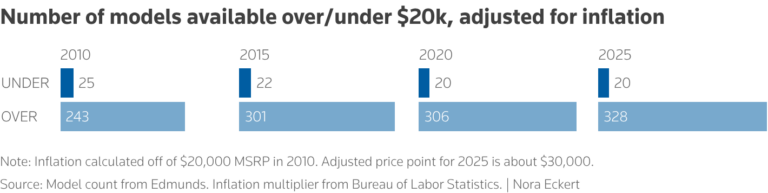
Meanwhile, truly budget-friendly options have become increasingly rare. In 2010, shoppers could choose from 25 models priced around $20,000 or less. By last year, that number had slipped to just 20 models at the inflation-adjusted equivalent—roughly $30,000 today—underscoring how the entry-level car is slowly disappearing from the market.
The result is a striking shift in who can afford to buy a new car—reshaping the income profile of America’s car-buying public almost entirely.
The share of new vehicles purchased by U.S. households earning $100,000 or less held steady at roughly 50% to 60% for years—until the start of this decade, according to vehicle-registration data from S&P Global Mobility. Since then, that balance has shifted sharply. By last year, buyers in the $100,000-or-less income bracket accounted for just 36% of new-vehicle sales, highlighting how quickly the market has tilted toward wealthier households.
"It’s truly a K economy for us," said Brad Sowers, a car dealer in the St. Louis area who operates dealerships for General Motors, Stellantis—the maker of Jeep—and Kia.
Pricier Cars, Bigger Profits
The shift has helped automakers post stronger profits even as overall vehicle sales have softened in recent years. Over time, Detroit’s traditional Big Three—General Motors, Ford Motor Company, and Stellantis—have steadily phased out many smaller, entry-level models in the U.S., replacing them with higher-margin trucks and SUVs that deliver bigger returns.
Many of those discontinued car lines carried relatively thin profit margins. By contrast, former auto executives say core margins on large SUVs and pickup trucks can top 20%. The payoff is clear: in 2024, General Motors generated about $4,200 in operating profit per vehicle sold in North America—up sharply from roughly $3,000 per vehicle in 2018.
Executives at General Motors say affordability remains a priority, pointing to several small SUVs positioned as accessible entry-level options—most notably the Chevrolet Trax and the Buick Envista, both of which have gained traction with budget-conscious buyers.
"We’ve been able to create a portfolio where we can make money top to bottom," said Paul Jacobson, chief financial officer of General Motors, speaking at an event last month.
In February, Ford Motor Company said it plans to offer five models priced under $40,000 by the end of the decade—including at least one electric vehicle expected to come in at around $30,000, a move aimed at bringing more affordable options back to the market.
The shift toward pricier vehicles is clearly reflected in Jeep, the iconic off-road and SUV brand owned by Stellantis. A decade ago, Jeep’s U.S. lineup—made up of roughly half a dozen models—started at prices ranging from about $17,000 to $30,000, a far more accessible entry point than many of today’s offerings.
Today, starting prices for Jeep vehicles in the U.S. run from roughly $30,000 to about $65,000 for the upscale Jeep Grand Wagoneer—a model that can easily top $100,000 when fully loaded. The sharp rise in Jeep’s pricing has helped boost profits for parent company Stellantis, but it has also come alongside a noticeable slide in the brand’s U.S. market share.
Antonio Filosa, who took over as CEO of Stellantis last year, says restoring affordability is now a key strategy to win back customers. As part of that push, Jeep has begun making features like LED lighting and heated steering wheels standard or more affordable. Combined with broader price cuts, the changes can add up to about $4,000 in extra value on certain models, the company says.
“I need to unlock some of the things that you love about Jeep, make them more affordable,” Jeep brand CEO Bob Broderdorf told Reuters in December.