Iran will press on with its fight and keep the Strait of Hormuz closed, using the vital waterway as leverage against the United States and Israel, the country’s new Supreme Leader, Mojtaba Khamenei, declared on Thursday.
The defiant statement marks his first public remarks since taking power after the killing of his father, Ali Khamenei—a moment that signals a hardline stance and sets the stage for rising tensions in one of the world’s most critical energy corridors.
Hours later, Benjamin Netanyahu stepped before cameras for his first press conference since the war began, delivering a stark and unmistakable message. The Israeli leader issued a thinly veiled threat against Mojtaba Khamenei while forcefully defending Israel’s sweeping military assault on Iran—an offensive that has already claimed thousands of lives and sent shockwaves through global energy markets and stock exchanges.
“I wouldn’t issue life insurance policies on any of the leaders of the terrorist organization,” Benjamin Netanyahu said, delivering the line with a pointed warning. “I don’t intend to give an exact message here about what we are planning or what we are going to do.”
Standing between two Israeli flags and answering questions through a video link, the Israeli prime minister left the message hanging in the air—hinting at possible moves ahead while keeping the details deliberately under wraps.
In Iran, Mojtaba Khamenei did not appear publicly. Instead, his remarks were read aloud by a presenter on state television. No images of the new supreme leader have surfaced since the Israeli strike that ignited the war—an attack that wiped out much of his family, including his father, Ali Khamenei, and his wife—adding a layer of mystery and tension to his sudden rise to power.
In the statement, Mojtaba Khamenei urged neighboring countries to shut down U.S. military bases operating on their soil, warning that any facilities still being used against Iran would remain in Tehran’s crosshairs. The message carried a stark warning: if those bases stay open, Iran will continue to strike them.
"I assure everyone that we will not neglect avenging the blood of your martyrs," the hardline cleric declared, vowing that Iran would relentlessly pursue revenge for those killed in the conflict. The warning from Mojtaba Khamenei underscored the uncompromising tone of his first message since taking power, signaling that retaliation remains at the heart of Tehran’s strategy as tensions continue to escalate.
"The popular demand is to continue our effective defense and make the enemy regret it," Mojtaba Khamenei said, adding that Iran must keep using one of its most powerful pressure points: blocking the Strait of Hormuz.
The narrow waterway—through which roughly one-fifth of the world’s oil supply normally flows along Iran’s coast—has become a critical lever in Tehran’s escalating standoff with the West.
Iranian state television gave no explanation for why the message was read by a presenter instead of being delivered in person by Mojtaba Khamenei. Iranian officials have said he was only lightly wounded during the initial February 28 airstrikes that ignited the conflict, but the true extent of his injuries remains unclear—fueling speculation about his condition and why he has yet to appear in public.
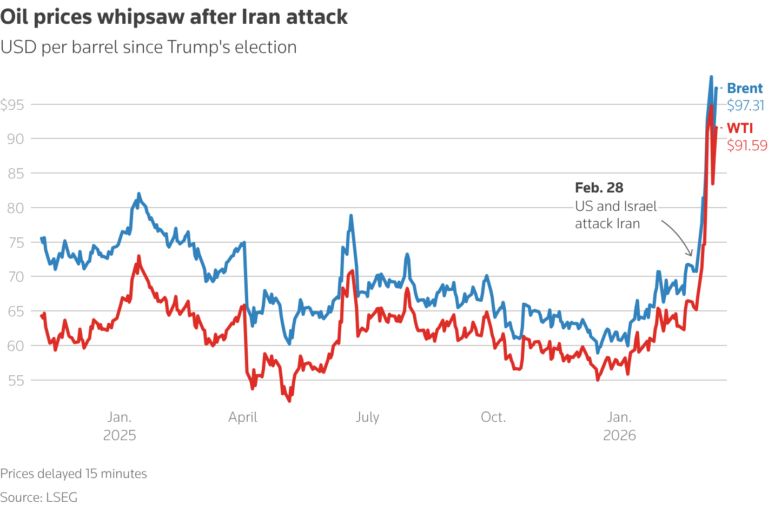
The growing risk of one of the most severe disruptions to global energy supplies in decades sent oil prices surging about 9%, pushing crude back to around $100 a barrel after earlier sliding in the week on hopes the conflict might end quickly. The sharp rebound underscored how fragile the market remains, as traders brace for the possibility that the crisis could choke off vital energy flows and ripple across the global economy.
U.S. stocks slid on Thursday, with the S&P 500 posting its steepest three-day percentage drop in a month as investors grew increasingly uneasy about the escalating conflict and its potential shockwaves across the global economy. The selloff signaled a sudden shift in market mood, as optimism earlier in the week quickly gave way to rising fear and uncertainty on Wall Street.
Flames Erupt as Oil Tankers Burn at Iraqi Port
Two oil tankers erupted in flames at an Iraqi port after being struck by suspected Iranian boats packed with explosives—an attack widely seen as a bold show of defiance against Donald Trump, who declared just a day earlier that the United States had already won the war. The fiery strike sent a stark message that the conflict may be far from over.
Images verified by Reuters and filmed at the port of Basra captured a dramatic scene: ships swallowed by towering orange fireballs that lit up the night sky. The devastating blast left at least one crew member dead, underscoring the deadly stakes as the conflict spills into vital energy hubs.
Just hours earlier, three other vessels were hit across the Gulf, signaling a widening threat to shipping in one of the world’s most critical trade corridors. Iran’s powerful Islamic Revolutionary Guard Corps claimed responsibility for at least one of the strikes—an attack that left a Thai bulk carrier engulfed in flames. Meanwhile, a separate container ship reported being struck by an unidentified projectile near the United Arab Emirates, raising fresh fears that the conflict is rapidly spreading across key maritime routes.
On another front in the increasingly unpredictable war, Israeli airstrikes slammed into a building in central Beirut on Thursday, sending thick plumes of smoke billowing over the Lebanese capital and rattling a city already on edge as the conflict spreads beyond its original battle lines.
Israel also ordered residents to evacuate another wide stretch of southern Lebanon, escalating its campaign against the Iran-backed militant group Hezbollah. The move came after the group unleashed its largest barrage of rockets into Israel since the war began, raising fears that the conflict is rapidly widening across the region.
So far, the war has claimed more than 2,000 lives, with nearly 700 of those deaths reported in Lebanon alone—a grim toll that highlights how quickly the violence is spreading and how devastating the human cost has already become.
As Drones Fill the Skies, Donald Trump Says the U.S. Stands to Gain
Casting doubt on U.S. and Israeli claims that much of Iran’s long-range arsenal had been destroyed, fresh waves of drones were reported flying across the region—entering the airspace of Kuwait, Iraq, United Arab Emirates, Bahrain, and Oman—a sign that Tehran may still have significant strike capability despite the ongoing bombardment.
In another troubling development, a U.S. military refueling aircraft crashed in western Iraq on Thursday. U.S. officials said the incident involved another aircraft but was not caused by hostile or friendly fire, leaving key questions about what exactly happened in the skies over the war zone.
Since the United States and Israel launched their strikes against Iran on February 28, seven U.S. service members have been killed—an early toll that highlights the growing risks as the conflict deepens.
Iran has warned it will not allow oil shipments to pass through the Strait of Hormuz until attacks by the United States and Israel come to an end. But Donald Trump brushed aside the surge in oil prices, signaling confidence that the situation will not derail the broader economic outlook despite mounting tensions in one of the world’s most critical energy corridors.
“The United States is the largest Oil Producer in the World, by far, so when oil prices go up, we make a lot of money,” Trump wrote on social media.
Scott Bessent told Sky News in an interview that the United States Navy could begin escorting ships through the Strait of Hormuz once military conditions allow—possibly alongside an international coalition—signaling a potential effort to reopen one of the world’s most vital energy corridors despite the escalating conflict.
The United States is both a net exporter of oil and the world’s largest consumer of it—a balance that leaves the economy highly sensitive to global price swings. Economists warn that if oil prices stay elevated for long, the ripple effects could spread quickly, fueling broader inflation and driving up costs across everything from transportation to everyday goods.
In a separate remark, Donald Trump said the Iran national football team would still be welcome to compete in the 2026 FIFA World Cup, which the United States is set to co-host. But he added a striking caveat, suggesting it might not be appropriate for the team to attend “for their own life and safety,” a comment that underscored how deeply the escalating conflict is beginning to ripple beyond the battlefield and into the world of global sport.
‘Security Forces Are Everywhere’
Inside Iran, residents say security forces have stepped up their presence across cities and key public areas, a visible show of strength meant to signal that the government still firmly holds the reins. The expanded patrols and checkpoints appear designed not only to deter unrest but also to project an image of control at a moment when tensions inside the country are running high.
“Security forces are everywhere, more than before. People are afraid to come out, but supermarkets are open,” teacher Majan, 35, said by phone from Tehran.
Israel said it had targeted checkpoints in Tehran run by the Basij, a volunteer militia tied to the powerful Islamic Revolutionary Guard Corps, striking positions the group uses to enforce security across the capital. The attacks highlight Israel’s expanding effort to weaken Iran’s internal security apparatus as the conflict pushes deeper inside the country.
Israel and the United States have urged Iranians to rise up and overthrow the country’s clerical leadership. Many people inside Iran have long called for change, and some even openly celebrated the death of the elder supreme leader, Ali Khamenei, on February 28—the first day of the war—after security forces under his rule had killed thousands of anti-government protesters in January.
Yet despite the anger and frustration simmering beneath the surface, there has been no clear sign of organized dissent as the country faces mounting attacks from abroad.
Tehran Aims to Trigger a Prolonged Global Economic Shock
Iran is signaling that its new strategy is to unleash a prolonged economic shock—one aimed at forcing Donald Trump to back down. A spokesperson for Iran’s military command warned on Wednesday that the world should brace for oil prices to soar as high as $200 a barrel, a stark reminder of how quickly the conflict could shake the global economy.
Chris Wright said Thursday that he does not expect oil prices to surge to that level, though he stopped short of ruling it out entirely. “I would say unlikely, but we are focused on the military operation and solving a problem,” Wright told CNN, signaling that Washington remains more concerned with the unfolding conflict than with short-term market volatility.
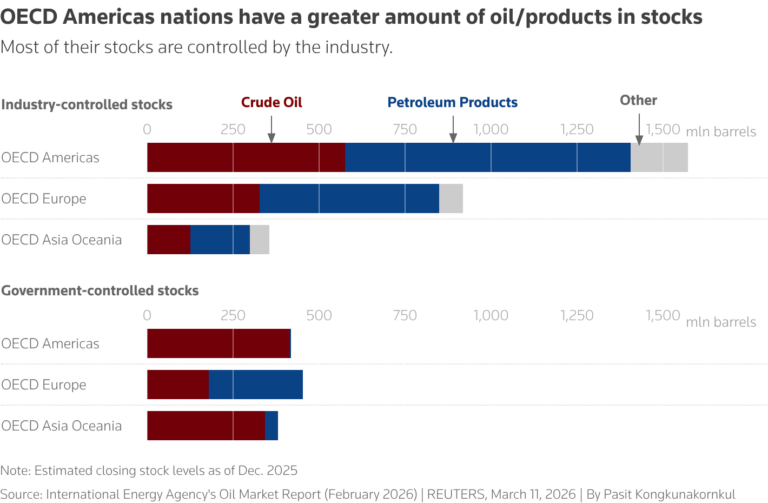
Oil prices continued to climb even after developed nations announced Wednesday that they would release 400 million barrels from their strategic reserves—nearly half of it coming from the United States. The move was meant to calm jittery markets, but the surge in prices showed that fears of deeper disruptions to global energy supplies are still gripping traders.