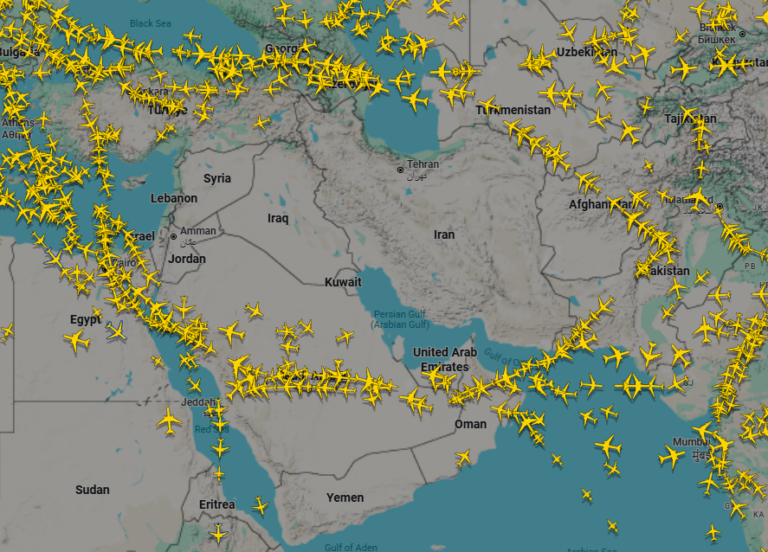
Emirates and Etihad Airways began cautiously restoring limited flights to major global destinations from their United Arab Emirates hubs on Friday, even as the looming threat of missile strikes continues to strain airline operations and intensify the race to move stranded travelers.
With much of the Middle East’s airspace still shut down due to missile and drone threats following the start of the U.S.-Israel war against Iran, authorities have been scrambling to organize charter flights and secure scarce seats on limited commercial services to evacuate tens of thousands of people.
A government-chartered Air France flight sent to bring French nationals home from the United Arab Emirates was forced to turn back on Thursday after missile fire was reported in the area, French Transport Minister Philippe Tabarot said—underscoring the growing risks facing evacuation efforts.
“This situation reflects the instability in the region and the complexity of repatriation operations,” he said.
Britain’s first repatriation flight from Oman touched down at London’s Stansted Airport early Friday after being rescheduled due to operational setbacks, including delays while boarding passengers—highlighting the complex logistics behind the evacuation effort.
Abu Dhabi–based Etihad said Friday it will restart a limited flight schedule through March 19, reconnecting its hub with about 70 destinations worldwide—including London, Paris, Frankfurt, Delhi, New York, Toronto, and Tel Aviv—as airlines cautiously rebuild operations.
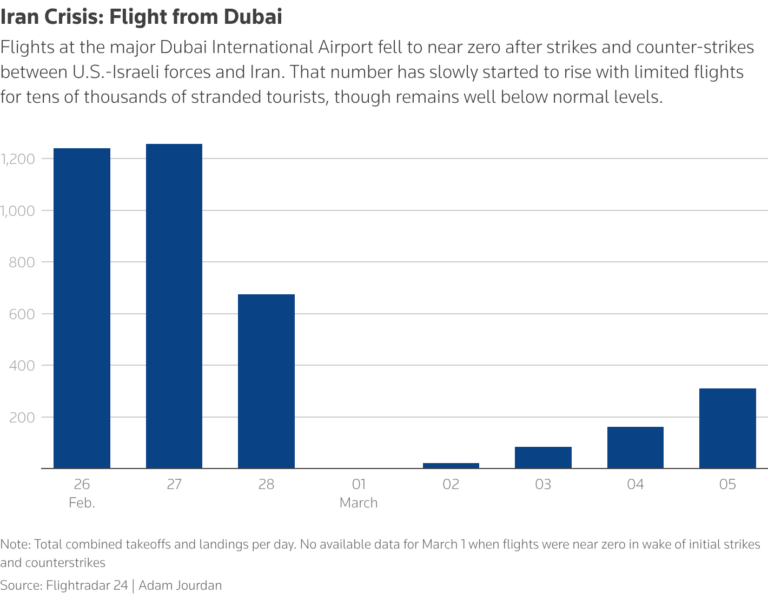
As of Thursday, traffic at Dubai International Airport—normally the world’s busiest—had nearly doubled from Wednesday, according to flight-tracking site Flightradar24. Even so, activity remained at just about 25% of its typical level, underscoring how sharply air travel in the region has slowed.
Dubai-based Emirates said late Thursday it is operating a reduced flight schedule to 82 destinations—including London, Sydney, Singapore, and New York—until further notice. The airline also warned that passengers transiting through Dubai will only be accepted if their onward connecting flight is confirmed to be operating, as carriers move cautiously amid ongoing disruptions.
The scaled-back operations at major Middle Eastern hubs have hit travelers especially hard on routes between Europe and the Asia-Pacific, disrupting one of the world’s busiest long-haul corridors and leaving many passengers scrambling for alternatives.
Together, Emirates, Qatar Airways, and Etihad typically carry about one-third of all passengers traveling from Europe to Asia—and more than half of those flying from Europe to Australia, New Zealand, and nearby Pacific islands—according to data from Cirium, highlighting just how crucial these Gulf carriers are to global travel.
Qatar’s main hub in Doha remains closed, but authorities have begun arranging a small number of relief flights from neighboring Oman and Saudi Arabia, offering a narrow lifeline for stranded travelers.
Data from Cirium shows the scale of the disruption: between February 28—when the conflict began—and March 5, more than 44,000 flights were scheduled to depart from or arrive in the Middle East, but over 25,000 of them have already been canceled.
Malaysia Airlines said it will add extra flights from Kuala Lumpur to London and Paris from Friday through Sunday to help accommodate passengers affected by the disruptions, while SriLankan Airlines announced an additional Colombo–London service on Sunday to ease the growing backlog of stranded travelers.
Jet Fuel Prices Surge as Airline Stocks Slide
Rising oil prices have pushed jet fuel costs sharply higher, with Singapore jet fuel (JET-SIN) climbing to a record $225 a barrel this week. Traders say the surge is being driven by growing fears that supplies from Middle Eastern refineries could tighten.
The price pulled back to about $195 a barrel on Thursday as traders locked in profits, but it still stood at nearly twice last week’s level—highlighting just how dramatically jet fuel costs have surged in a matter of days.
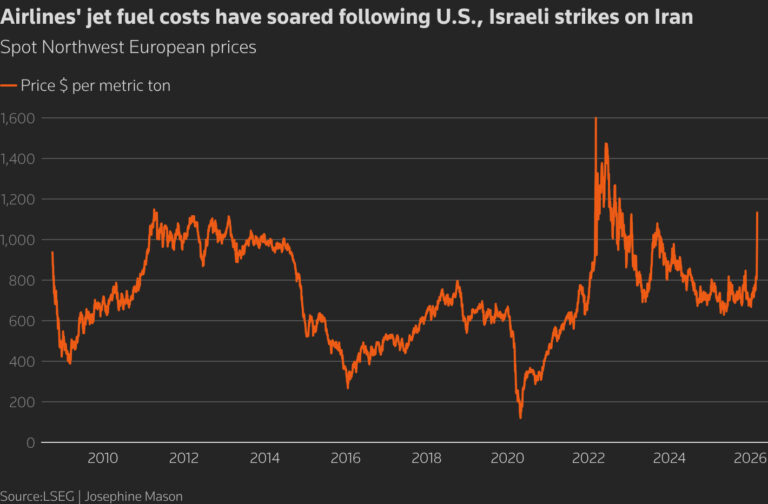
“As well as lost revenue, airlines are likely to be affected by higher fuel prices,” Fitch Ratings said.
Fuel-hedging strategies vary widely among airlines, but Fitch says most carriers across Europe, the Middle East, and Africa have locked in roughly 50% to 80% of their fuel needs for the next three months—offering some protection as prices swing wildly.
Across Asia, airline stocks came under pressure on Friday: Qantas Airways slipped more than 1%, Air New Zealand tumbled 6.4%, Hong Kong’s flagship carrier Cathay Pacific fell 1%, Singapore Airlines edged down 0.6%, and Korean Air Lines dropped 2%.
Shares of major Chinese carriers listed in Hong Kong—including Air China, China Eastern Airlines, and China Southern Airlines—were largely unchanged, while Japan Airlines’ stock also held steady, bucking the broader slide in regional airline shares.
Travelers Describe Chaos as the Rush to Leave Intensifies
With the conflict showing no clear signs of easing, disruptions to passenger flights and air cargo across the region appear likely to drag on—leaving airlines, freight operators, and travelers bracing for prolonged turbulence.
Passengers have been paying staggering sums to escape the Middle East, and some who managed to catch commercial flights from Oman on Thursday said the scramble to get home from Dubai had been “absolute chaos,” as travelers fought for scarce seats and last-minute routes out.
“We paid 1,500 pounds ($2,005.05) to get across to Muscat (Oman) to get on the plane,” said Ed Short after he arrived at London’s Heathrow Airport on a British Airways flight.
“We’d spent about 20,000 pounds booking Emirates flight instead. So we’re hoping we get those back.”
($1 = 0.7481 pounds)
Photograph: A Lufthansa plane from Muscat, Oman, the first evacuation flight on behalf of the German government, lands at Frankfurt Airport in Frankfurt/Main, Germany on Thursday, March 5, 2026. (Hannes P. Albert/dpa via AP)