Marine insurers are pulling war-risk coverage for vessels as the escalating conflict with Iran rattles global shipping lanes. With at least three tankers damaged, one seafarer confirmed dead, and roughly 150 ships stranded near the Strait of Hormuz, oil shipping rates are poised to climb even higher—intensifying pressure on an already fragile energy market.
Iran has fired back at U.S. and Israeli strikes that began Saturday, launching retaliatory attacks that have dramatically heightened the danger for commercial shipping over the past 24 hours—raising fresh concerns about the safety of key global trade routes.
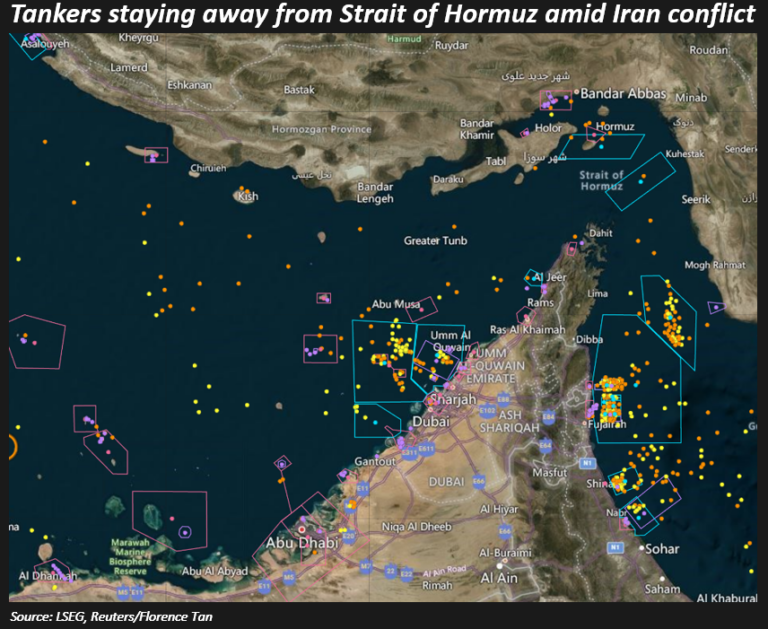
In the Strait of Hormuz and nearby waters, at least 150 vessels—including oil and liquefied natural gas tankers—had dropped anchor by Sunday, according to shipping data, underscoring the growing unease rippling through one of the world’s most critical energy corridors.
Under normal conditions, tankers moving roughly one-fifth of the world’s oil supply—from Saudi Arabia, the United Arab Emirates, Iraq, Iran, and Kuwait—pass through the Strait, alongside ships loaded with diesel, jet fuel, gasoline, and other refined products. Any disruption here doesn’t just slow traffic; it sends shockwaves through the global energy market.
The disruption sent global oil prices soaring 9% on Monday, a sharp spike that signaled just how quickly tensions in the region can rattle energy markets worldwide.
Insurers Pull War-Risk Coverage as Tensions Escalate
Companies including Gard, Skuld, NorthStandard, London P&I Club, and American Club announced that their war-risk coverage cancellations will take effect March 5, according to notices posted on their websites and dated March 1—signaling a swift and coordinated retreat from one of the world’s most volatile shipping corridors.
According to the notices, war-risk coverage will no longer apply in Iranian waters, the Gulf, or surrounding areas—effectively stripping vessels of critical protection in one of the world’s most volatile maritime flashpoints.
Skuld added in its notice that it is developing a buy-back option that would allow shipowners to reinstate war-risk coverage—offering a potential lifeline as uncertainty continues to grip the region.
Japan’s MS&AD Insurance Group told Reuters it has suspended underwriting a broad range of war-risk policies covering waters around Iran, Israel, and neighboring countries—another clear sign that insurers are rapidly retreating as tensions escalate across the region.
Oil Shipping Costs Set to Climb Even Higher as Risks Intensify
Meanwhile, the cost of shipping oil from the Middle East to Asia—already hovering near six-year highs—is poised to climb even further. As the expanding Iran conflict makes shipowners increasingly wary of sending vessels into the region, market sources and analysts said Monday that freight rates are likely to surge again, tightening supply lines and adding fresh strain to global energy markets.
Spot shipping rates from the Middle East to Asia—better known in the market as TD3C (DFRT-ME-CN)—are expected to climb even higher, shipbrokers said. The key benchmark has already nearly tripled since the start of 2026, a stunning surge that underscores just how quickly geopolitical tensions can drive up the cost of moving oil across the globe.
Shipbrokers estimated that the spot rate to charter a very large crude carrier (VLCC) on the critical Middle East–to–China route was up about 4% early Monday in Asia compared with Friday. The rate was hovering near W225 on the Worldscale benchmark—equivalent to at least $12 million per voyage—highlighting how rapidly shipping costs are accelerating as tensions tighten their grip on the market.
Explosive Surge That’s Rewriting the Market Rules
“TD3C rates were rising exponentially before the attacks and will continue to remain elevated as countries scramble to meet their energy needs,” said Emril Jamil, a senior LSEG analyst.
“There’s still considerable uncertainty about where rates will ultimately settle on Monday, but all Middle East loading routes are expected to remain firm,” a shipbroker said, speaking on condition of anonymity because they were not authorized to speak publicly. The comment underscores just how tense and fluid the market has become, with traders bracing for further swings as the day unfolds.
At the same time, the market is likely to require more vessels to lift crude from the U.S. and West Africa on longer-haul voyages, a source at a shipping company said. That added demand for ships could push freight rates even higher on those routes, extending the ripple effects of the crisis far beyond the Middle East.