Just two days before New York’s most powerful snowstorm in a decade roared to life, forecasters were still wrestling with a critical question: How much snow was really coming?
One long-standing U.S. forecasting model had been sounding the alarm for a direct, punishing hit. But a new generation of artificial intelligence tools told a far less certain story—setting up a high-stakes showdown between tradition and technology as the storm closed in.
The long-running Global Forecast System (GFS) was flashing red, warning that the storm could wallop much of the Northeast. But memories of the model’s past misfires lingered — and it was largely alone in forecasting such extreme impacts. That hesitation kept many forecasters on edge, holding back until Friday afternoon before finally acknowledging the real possibility that parts of New York could be buried under more than a foot of snow.
The snowfall totals reported by the National Weather Service have been nothing short of staggering. Central Park was buried under nearly 20 inches — ranking among its largest snowstorms on record. Out on Long Island, the numbers climbed even higher, with some communities digging out from more than two feet of snow.
Predicting a powerful winter storm is a different beast altogether, scientists say. Unlike hurricanes — which churn over open water for days before slamming into shore — nor’easters can rapidly organize and hammer the East Coast in less than 24 hours.
To get ahead of this week’s storm, forecasters had to pinpoint exactly where surges of Arctic air and moisture would collide — and how they would interact with a ribbon of low pressure racing along the jet stream — all several days before the first flakes began to fall.
So far, artificial intelligence hasn’t made that high-wire act much easier, said Bob Oravec, a senior forecaster at the Weather Prediction Center in Maryland. Despite the buzz surrounding next-generation models, he noted, the challenge of nailing down a fast-moving winter storm remains as daunting as ever — and the margin for error razor thin.
“There’s no perfect model yet,” Oravec said. “That’s the problem.”
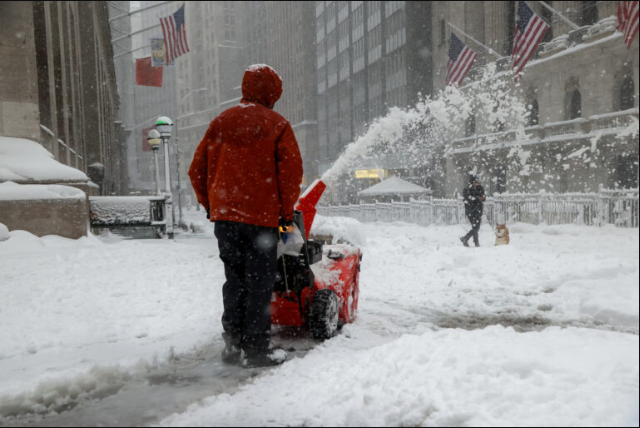
A bundled-up worker battles heavy snowfall outside the New York Stock Exchange as a powerful winter storm sweeps through New York on Feb. 23. The scene — captured by photographer Michael Nagle for Bloomberg L.P. — underscores the storm’s grip on the heart of America’s financial district.
In the U.S., storm watches and warnings are issued by the National Weather Service and then amplified by private forecasting firms. For this storm, responsibility fell to the agency’s local office in Upton, New York, which oversees safety alerts for New York City and parts of New Jersey and Connecticut.
Forecaster David Stark said the team held off on issuing its first alerts until Friday, as lingering uncertainty over the storm’s exact track kept officials cautious — a reminder of how even a slight shift can mean the difference between a nuisance snowfall and a paralyzing blizzard.
“We don’t like to put out warnings early and give a false sense of alarm if it’s not needed,” Stark said.
While the GFS — developed by the National Oceanic and Atmospheric Administration — ultimately nailed the storm’s impact on New York City, scientists say it wasn’t flawless. The model overstated the threat across parts of the Mid-Atlantic and slightly misjudged how long the storm would linger — a reminder that even when the headline forecast is right, the finer details can still make or break the story.
But as of Tuesday morning, a powerful new European AI-driven model is telling a different story, projecting a far lower threat. The conflicting outlooks are once again putting forecasters on edge — and raising the stakes for what could come next.
Though the models are likely to shift again in the days ahead, Andrew Kruczkiewicz of the Columbia Climate School** says he’s focused on something just as critical: how forecasters weigh AI-driven projections before sounding the alarm to the public.
As the next storm takes shape, he’s watching closely to see whether cutting-edge algorithms earn forecasters’ trust — or whether human judgment still carries the final word when it matters most.
“We’re so trained to think anything AI is better,” said Kruczkiewicz. “Even if models are considered better or high quality, decision-making is not necessarily simplified.”