New Yorkers are leaning into the power of the free market — and they’re doing it with unmistakable energy.
Hundreds lined up Thursday for a shot at shopping inside the city’s “first free grocery store” — an attention-grabbing launch by Polymarket as it and other prediction betting platforms come under growing scrutiny from state regulators.
The West Village pop-up — widely seen as a pointed nod to Mayor Zohran Mamdani’s proposal for government-run grocery stores — drew more than 400 New Yorkers. They began lining up hours before the 2 p.m. opening, eager to pack blue tote bags with free produce, pantry staples, and everyday essentials, turning an ordinary afternoon into a scene that felt more like a movement than a shopping trip.
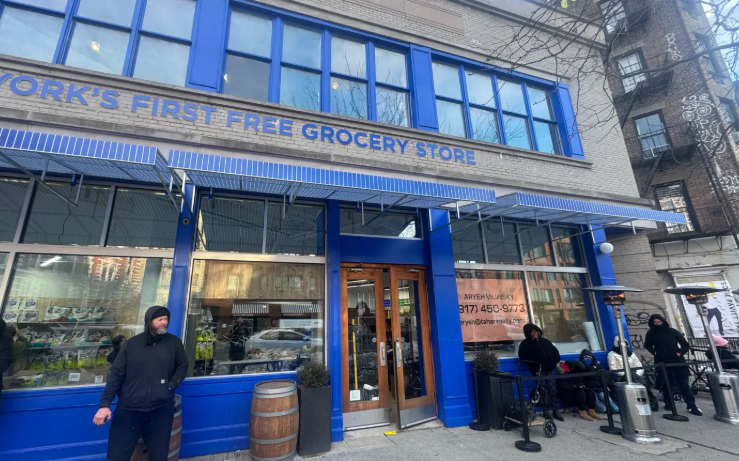
Hundreds of city residents packed the West Village on Thursday afternoon, lining up for a chance to shop at betting platform Polymarket’s buzzworthy “free grocery store” — a promotion that quickly turned an ordinary weekday into one of the neighborhood’s most talked-about scenes. Robert Miller
“Times are hard. Things are very expensive, so this helps,” said Forest Hills resident Tori Hall, who was second in line outside the pop-up store. “It goes a long way.”
The eye-catching promotion came on the heels of a similar play by rival prediction market Kalshi, which earlier this month offered East Village shoppers a $50 grocery giveaway — escalating a competition that’s quickly spilling from online betting boards onto neighborhood streets.
Mayor Zohran Mamdani didn’t let the moment pass quietly. Responding to Polymarket’s free-store announcement on X this month, he cheekily shared a photo of a tongue-in-cheek headline that read: “Heartbreaking: The worst person you know just made a great point.”
The fast-growing betting app — which lets users place wagers on everything from military actions to high-stakes political outcomes — has also sparked mounting concern. Critics warn that access to classified or other so-called “insider” information could give some bettors an unfair edge, raising uncomfortable questions about where prediction ends and privileged knowledge begins.
Just this week, an Israel Defense Forces reservist and a civilian were indicted in Israel for allegedly using classified military intelligence to place bets on the platform — a case first reported by The Block. The charges have intensified scrutiny around how sensitive information could potentially be leveraged for profit in the fast-moving world of prediction markets.
Prediction markets have also drawn sharp criticism from Letitia James. In a pre–Super Bowl consumer alert, the New York attorney general warned that some of these platforms may violate state gambling laws and could expose users to “significant financial risk” — a stark caution just as betting interest surges around one of the year’s biggest sporting events.
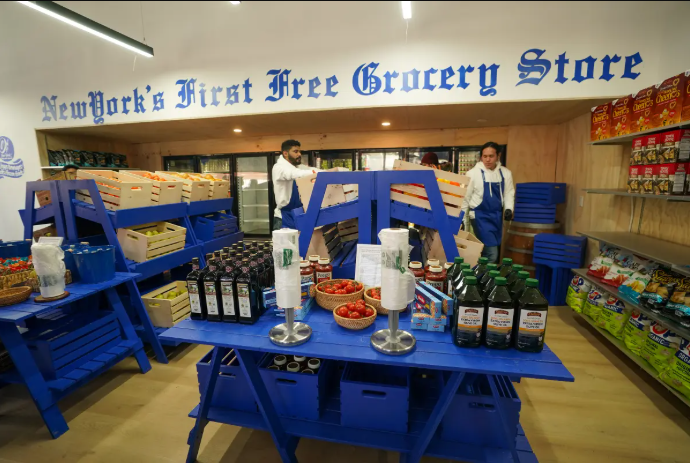
The shop attracted more than 400 eager shoppers, many of whom began lining up hours before the 2 p.m. opening — a growing crowd that signaled this was far more than an ordinary afternoon errand. Robert Miller
Last year, State Assemblymember Clyde Vanel (D-Queens) introduced legislation that would classify certain prediction market contracts as “unlicensed gambling” — a move that could significantly reshape how these fast-growing platforms operate in New York and beyond.
Websites found in violation could face steep civil penalties — up to $50,000 per infraction, or as much as $1 million for every day they allow wagers on “sensitive” topics such as deadly incidents or political elections. The proposed fines send a clear message: regulators are prepared to hit hard where it hurts most — the bottom line.
Shoppers at Polymarket’s free store appeared largely unfazed by the surrounding controversy. Several told The Post they hope the company’s giveaways aren’t just a one-time splash, but the start of something more permanent — a benefit they’d gladly see stick around long after the headlines fade.
"If it is [a publicity stunt], then I got some free food coming out of here … This is exactly what a food bank does," said Hall, a 58-year-old paralegal and mother who showed up at 6 a.m. to secure her spot at the front of the line, determined not to miss out.
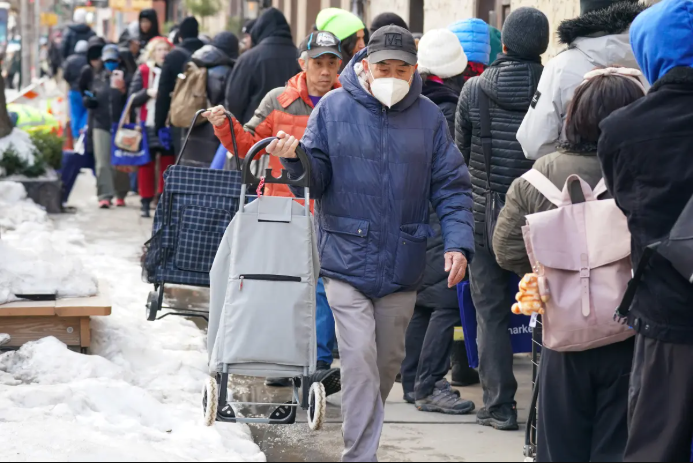
The Charles Street store will open daily from 2 to 5 p.m. through Monday — a limited window that’s likely to keep lines forming as word continues to spread. Robert Miller
She walked away with everyday essentials — socks, tampons, and toilet paper — along with fresh bananas and apples, ground beef, and cartons of organic eggs, a haul that turned a simple visit into a meaningful score.
“I hate going grocery shopping because I’m spending $150 to $200 every time,” she said. “We just need a helping hand.”
"Groceries cost a lot. It’s terrible," agreed Dayna V., an East Harlem resident who claimed the very first spot in line. By the time she left, she was carrying three tote bags stuffed to the brim with food and household essentials — proof of just how much the rising cost of living is weighing on everyday New Yorkers.
"The eggs right now, it’s $10 and up, so this [free store] is good," said the 43-year-old Manhattan resident, who is currently unemployed — underscoring just how sharply rising grocery prices are squeezing those already on the margins.
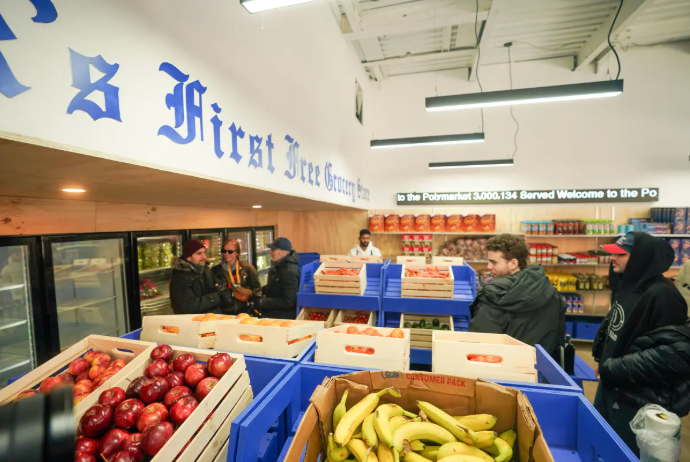
In a statement, Polymarket said it has donated $1 million to Food Bank For New York City “to help fight food insecurity across all five boroughs” — a significant pledge that adds another layer to the company’s highly visible push into the city’s grocery debate. Robert Miller
“I love Polymarket!” she exclaimed, showing off her haul of Cheerios, juice, sweet potato chips and fabric softener. “I hope they … create more of it, and I hope this is really here to stay in the future.”
The Charles Street store will operate from 2 to 5 p.m. each day through Monday — a brief run that’s expected to keep excitement high and lines forming as long as the doors stay open.
In a statement, Polymarket said it has also contributed $1 million to Food Bank For New York City “to help fight food insecurity across all five boroughs” — a sizable donation that underscores the company’s effort to frame its high-profile promotion as part of a broader response to the city’s growing affordability crisis.
Grocery prices in New York City surged by a staggering 65.8% between 2012 and 2023, according to a report released last year by the state comptroller’s office — a sharp climb that helps explain why even a temporary “free” store can draw hundreds within hours.
The same report found that one in nine households statewide faced food insecurity between 2020 and 2022 — with most of those struggling families living in the five boroughs. The numbers paint a sobering picture of a crisis that is hitting hardest in the heart of the city.
Software engineer Luke McInerney, 31, of Manhattan, came prepared. He set up a folding chair, opened his laptop, and worked remotely while waiting for the grocery store doors to open — turning a long line into just another productive part of his day.
“I just think this is a quintessential New York experience,” he said. “Everyone out here in the cold together. There’s a camaraderie to it.”