With virtually no debate and barely a word of discussion, a final committee in the Florida House on Tuesday signed off on a bill to create a clearinghouse designed to shift commercial insurance policies out of Citizens Property Insurance Corp. and into the surplus lines market—an effort that could significantly reshape Florida’s property insurance landscape.
The House Commerce Committee—the bill’s last hurdle before reaching the full House—approved a sweeping “strike-all” amendment after state regulators, along with several insurance brokers and agents, voiced mounting concerns in recent weeks, setting the stage for an intense debate as the measure heads to the floor.
But the version that ultimately cleared the committee includes few—if any—of the revisions sought by agents and Insurance Commissioner Michael Yaworsky, despite assurances from the bill’s sponsor suggesting their concerns had been addressed—raising fresh questions about what, exactly, changed behind the scenes.
"What we’re offering in the strike-all is very generous in terms of more oversight" said state Rep. Mike Redondo, a Miami-based plaintiffs’ attorney, arguing that the amendment would significantly expand the authority of the state’s Office of Insurance Regulation—even as critics remain unconvinced.
Michael Yaworsky did not address the committee, citing a scheduling conflict. Still, he had already met with Rep. Mike Redondo and other lawmakers to lay out his concerns ahead of the vote, according to Kylie Mason, communications director for the Office of Insurance Regulation—signaling that the debate had been unfolding behind closed doors well before the public session began.
Those concerns ultimately fell on deaf ears, as the committee moved forward without adopting the changes—despite the warnings raised behind the scenes.
“Most of the improvements are illusory and the legislation is totally inconsistent with the way insurance is regulated across the United States, including Florida,” Mason said in an email. “Continued improvements are necessary.”
Michael Yaworsky’s team had recently drafted its own version of the clearinghouse proposal—one that would have given the Office of Insurance Regulation greater control over which insurers could participate and who would oversee the program. But the measure approved Tuesday reflects almost none of those recommendations.
Lawmakers are expected to eventually fold the House proposal into the Senate measure, SB 1028—a move that could fast-track the bill toward final passage. If that happens, it would leave little room for Michael Yaworsky’s proposed safeguards to gain traction before the legislative session is scheduled to adjourn on March 13, tightening the clock on any last-minute changes.
The amended House Commerce Committee bill and its Senate counterpart have ignited outrage across parts of the insurance industry. Critics say the measures would hand sweeping authority to a program administrator—potentially a brokerage—to decide which insurers and brokers can participate and pursue takeouts of commercial policies from Citizens Property Insurance Corporation.
Opponents argue the structure tilts heavily toward surplus lines carriers, while sidelining admitted insurers. By contrast, Michael Yaworsky’s alternative proposal would have required admitted carriers to be part of the process—an inclusion supporters say is critical to maintaining balance and regulatory oversight.
Some Florida brokers contend the bill appears tailored to benefit one major national brokerage, Ryan Turner, whose leadership has been a significant donor to Republican causes. In recent weeks, the firm has also circulated detailed, multi-page presentations to lawmakers outlining its vision for the proposed clearinghouse—fueling speculation about its influence as the legislation advances.
Other brokers and agents argue that a commercial clearinghouse is a solution in search of a problem, pointing to what they describe as a revitalized Florida insurance market that is finally operating as intended—raising the question of why lawmakers are pushing to overhaul a system that, by many accounts, is already stabilizing.
Michael Yaworsky’s alternative proposal would have imposed clear guardrails, including a requirement that any program administrator be headquartered in Florida and remain “free of all potential conflicts of interest.” Such provisions could effectively sideline firms like Ryan Specialty, which is based in Chicago—adding another layer of tension to an already contentious debate.
The approved measure also retains an “equalization adjustment” that could compel Citizens Property Insurance Corporation to raise its premiums to align with surplus lines offers. That shift could open the door to takeouts even when a private carrier’s rate is not within the current statutory 20% threshold of Citizens’ pricing—potentially rewriting the rules that have long governed when policies can move out of the state-backed insurer.
Officials at Citizens Property Insurance Corporation have not publicly taken a position on the bill. Still, sources say there is growing unease—both inside and outside the state-backed insurer—about how the clearinghouse, as currently structured, could disrupt Citizens’ broader depopulation strategy and reshape its path forward.
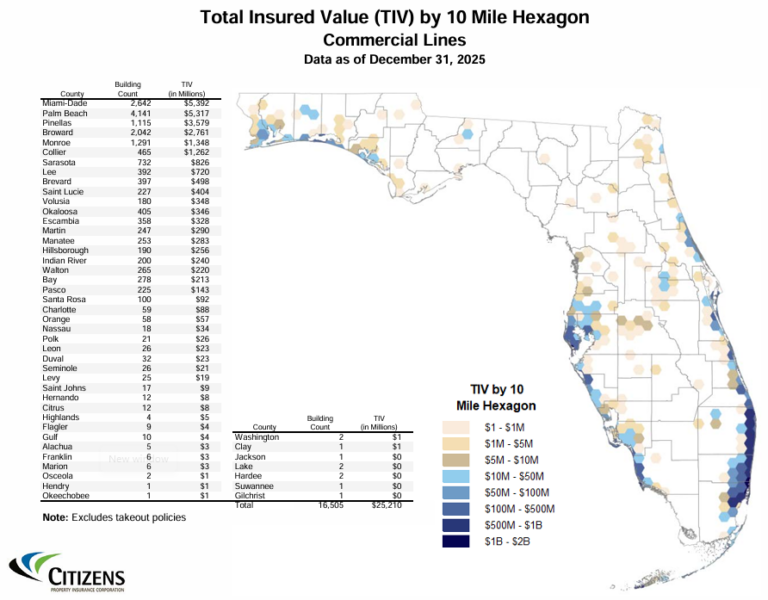
Although the number of commercial and commercial residential policies held by Citizens Property Insurance Corporation is relatively small—and shrinking, with fewer than 6,200 policies on the books as of early this year—the financial stakes remain enormous for agents and brokers operating in Florida’s commercial market. According to Citizens’ data, those policies represent more than $25 billion in total insured value statewide, underscoring why even a limited shift could carry outsized consequences.
The data show that policies in Miami-Dade County and Palm Beach County alone account for nearly $11 billion in insured value—concentrating a significant share of the exposure in just two South Florida markets and amplifying what’s at stake if the rules governing those policies begin to shift.
Photo: Rene Garcia Redondo speaks during Tuesday’s committee meeting, captured by The Florida Channel — a moment that quickly drew attention inside and beyond the hearing room.