A wave of insurance capital is pouring into private markets, igniting a hiring spree and driving compensation sharply higher—even as recent market jitters rattle investor confidence.
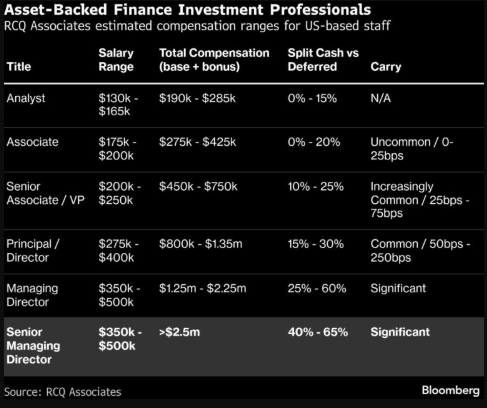
Senior managing directors are now commanding pay packages starting at $2.5 million and climbing well beyond that, underscoring just how fierce the competition for top talent has become.
Those are among the standout findings in the latest credit industry recruitment report from RCQ Associates. The firm found that hiring mandates for professionals with asset-backed finance expertise surged nearly 60% in 2025 compared with the previous year—a striking jump that highlights how aggressively firms are chasing specialized talent.
And for candidates with the right skills, the rewards go far beyond a strong base salary and bonus. Compensation packages are increasingly sweetened with “significant” carried interest—a direct share of profits—turning top roles into potentially life-changing paydays, according to RCQ.
Pacific Investment Management Co. recently pulled in more than $7 billion for its asset-based finance strategy, marking a major show of investor appetite for the space. The haul includes its first funds created exclusively for insurance companies and high-net-worth individuals—a strategic expansion that underscores just how aggressively capital is moving into private credit. The milestone was first reported by Bloomberg in December.
"RCQ expects the ABF talent market to remain tight given the continued high volumes of insurance capital flowing into the market," the report said. In other words, competition for skilled professionals isn’t easing anytime soon.
The scramble for talent is being fueled by the sheer amount of “dry powder” sitting on the sidelines—capital raised from investors but not yet put to work. According to estimates from Bloomberg Intelligence, private credit firms are currently holding about $543 billion in undeployed funds, a staggering war chest that all but guarantees the hiring race will intensify.
Asset-based finance has emerged as one of the fastest-growing corners of the private credit market, largely because these investments are backed by pools of financial or contractual collateral—adding a layer of protection that investors value in uncertain times.
For insurers, the appeal is clear. The asset class offers long-duration, often investment-grade opportunities with steady, predictable cash flows—exactly the kind of stability they need to match long-term liabilities while still reaching for higher returns.
Private credit firms are increasingly steering investments toward insurers they’ve launched or acquired themselves—a trend that’s raising fresh questions about how deeply intertwined the two industries have become. As capital circulates within these closely linked networks, the structures are growing more complex—and harder to untangle.
Earlier this month, Blue Owl Capital Inc. sold a $1.4 billion loan portfolio to three pension funds and its own insurance asset manager, a transaction that underscores just how interconnected these relationships now are.
Private credit has steadily claimed a larger share of insurers’ portfolios—particularly in North America—now accounting for roughly one-third of their total investments, according to a report released in October by the International Monetary Fund.
Much of that exposure is labeled investment grade, in part because insurers typically invest in the senior tranches of collateralized loan obligations (CLOs) and collateralized fund obligations (CFOs). By positioning themselves at the top of the capital stack, insurers aim to capture attractive yields while maintaining a layer of protection—an approach that helps explain why private credit continues to gain ground despite growing scrutiny.
In November, Golub Capital priced a CLO designed to lock investors in for longer than a typical deal—an approach that makes it easier for insurers to align asset maturities with long-term liabilities. The structure reflects a growing push to tailor private credit products more precisely to insurance balance sheets.
Meanwhile, RCQ Associates reported a “significant uptick” in CFO issuance, alongside a surge of more than 30% in clients seeking professionals with structuring and product expertise in the space. The message from the market is unmistakable: as issuance grows more sophisticated, the hunt for specialized talent is accelerating just as quickly.
Sell-Side Hiring
Hiring in structured finance at investment banks is poised to accelerate even further, with rising demand for professionals who know how to finance digital infrastructure assets such as data centers, according to a report from RCQ Associates.
Banks are also beefing up their teams with talent experienced in providing leverage to private credit managers and credit opportunity funds. As capital pours into next-generation assets and more complex credit strategies, institutions are racing to secure specialists who can structure, scale, and safeguard these increasingly sophisticated deals.
A U.S.-based senior managing director leading a desk that originates or syndicates securitization products such as CLOs can command annual compensation north of $2.25 million, according to the report.
At the top end of the market, the pay scale climbs even higher. The most senior bankers on fund and private capital solutions desks are earning more than $2 million a year—underscoring just how lucrative these roles have become as competition for elite structured finance talent intensifies.
In January, the headhunting firm surveyed private credit professionals to gauge whether their teams would expand over the next 12 months. The results point to steady momentum in the sector.
Out of 1,320 respondents, 56% said they expect net headcount growth, signaling plans to hire more staff. Another 30% anticipate their teams will hold steady, while just 8% foresee a reduction in size. The takeaway is hard to ignore: despite pockets of uncertainty, most firms are still leaning into growth rather than pulling back.
Photograph: New York City; photo credit: Michael Nagle/Bloomberg